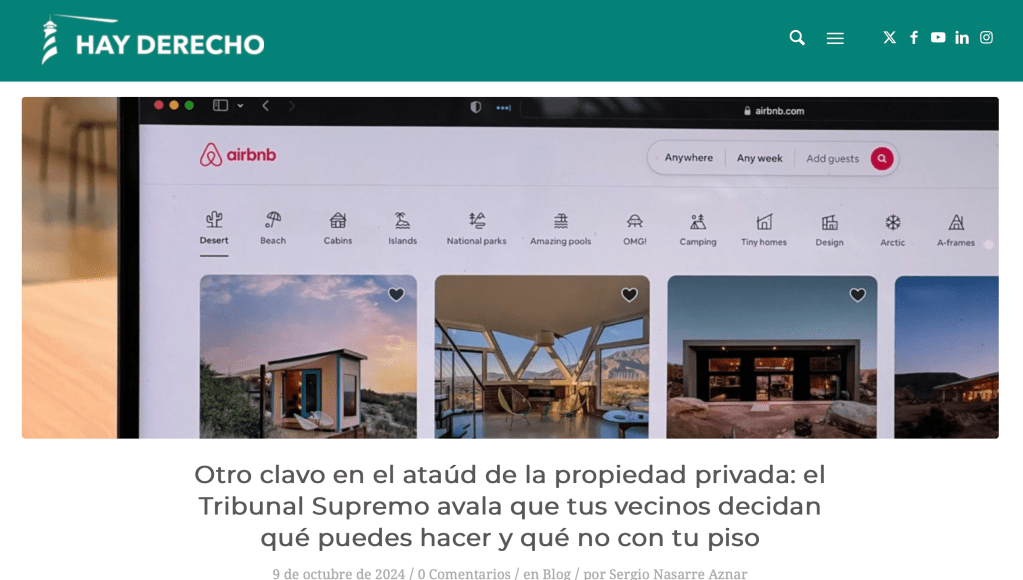
Hay Derecho, 9-10-2024. Texto completo disponible aquí.

Hay Derecho, 9-10-2024. Texto completo disponible aquí.


Revista Suroeste, 11-9-2024. Texto completo aquí.
«La propiedad privada es la única institución […] que se alza como protección de los individuos y de las familias frente los abusos de los poderosos«.

Font et al, Language and the use of law are predictive of judge gender and seniority, EPJ Data Science, 2024. https://doi.org/10.1140/epjds/s13688-024-00494-x
Disponible a texto completo aquí.
Abstract
There are examples of how unconscious bias can influence actions of people. In the judiciary, however, despite some examples there is no general theory on whether different demographic attributes such as gender, seniority or ethnicity affect case sentencing. We aim to gain insight into this issue by analyzing over 100k decisions of three different areas of law with the goal of understanding whether judge identity or judge attributes such as gender and seniority can be inferred from decision documents. We find that stylistic features of decisions are predictive of judge identities, their gender and their seniority, a finding that is aligned with results from analysis of written texts outside the judiciary. Surprisingly, we find that features based on legislation cited are also predictive of judge identities and attributes. While own content reuse by judges can explain our ability to predict judge identities, no specific reduced set of features can explain the differences we find in the legislation cited of decisions when we group judges by gender or seniority. Our findings open the door for further research on how these differences translate into how judges apply the law and, ultimately, to promote a more transparent and fair judiciary system.

S. Nasarre Aznar, “Un posible futuro para el Código Civil de Cataluña. Atención especial a los aspectos patrimoniales”, en Veinte años del Código civil de Cataluña, Departamento de Justicia, Barcelona, 2024, Generalitat de Cataluña.
Se desarrollan cuatro retos: la progresiva intromisión del Derecho público en las relaciones privadas, la tecnología, la mayor complejidad del Derecho civil y la adaptación a necesidades sociales (vivienda, familia, enseñanza).
Puede descargarse a texto completo aquí.
ACEPrensa, 22-7-2024. Texto completo aquí.


El EHS está ya activado, tras 4 años de trabajo. Cubre el estudio de la vivienda desde la óptica económica, social y legal. Es totalmente online, se adapta la ritmo del estudiante y está lleno de recursos para ayudar al aprendizaje, como vídeos, esquemas y juegos.
Tiene la opción de conseguir un título académico.
Sobre la elaboración del curso escribí este texto.
Puede encontrarse toda la información sobre el mismo en https://www.housingstudies.eu
 Sergio Nasarre Aznar
